
This page explains the methodology and findings underpinning the figures on the page What is known about the effectiveness of financial advice? It is aimed at professionals and researchers. Every figure cited there can be verified here.
Jev is the language model that read and scored every page. It is made by TypeSafe, an Australian company, and was run at version jev-1.13.0; part 2.3 says what it was asked.
Written on 11 October 2026. Every table comes from scripts/claims/report_tables.py in the typesafeadvisers repository. The script reads the study's files in data/claims/. No figure in a table was typed by hand. The table numbers are the script's, so there are gaps where a table was left off this page.
The Investment Tools page on the research into adviser performance covers what has been measured. This page shows what advisers claim about themselves on their own websites. It examines how often advisers promise higher returns, claim to outperform other advisers, or describe themselves as the best. It also examines how often they highlight their own quality or promise their clients further benefits. Finally, it examines the reasons they give and whether they claim independence.
The pages are the directory's archive of advisers' own websites and Financial Services Guides (FSGs). They were captured from 27 August to 26 September 2026. The findings cover 8,967 pages from 2,220 websites and 4,277 advisers, 28 per cent of the current advisers on the register.
Table T3. Capture month of the pages in the findings, by kind
| Month | Web pages | FSGs | All |
|---|---|---|---|
| 2026-08 | 4,301 | 455 | 4,756 |
| 2026-09 | 3,170 | 1,041 | 4,211 |
Capture dates run from 2026-08-27 to 2026-09-26.
Jev, TypeSafe's model, read every page. The full run scored 9,507 pages, including 134 duplicates; merging them left 9,373 pages.
The version used was jev-1.13.0.
Jev read at most 12,000 characters of a page. For a longer FSG, it also read a 600-character window around each restricted word ("independent" and its relatives). It read ten windows at most.
Table T4. What Jev read: clipping and empty pages (pages in the findings)
| Measure | Web pages | FSGs |
|---|---|---|
| Pages | 7,471 | 1,496 |
| Clipped at 12,000 characters | 436 (5.8%) | n/a |
| Longer than 12,000 characters (restricted-word windows added) | n/a | 393 (26.3%) |
| Under 200 characters of text | 83 | 40 |
| No text at all | 5 | 40 |
Five dimensions were scored on one five-step scale.
| Score | Meaning |
|---|---|
| 0 | No such claim on the page |
| 1 | A passing or implied mention only |
| 2 | A clear claim, made once, in body text |
| 3 | A clear claim repeated, or under its own heading |
| 4 | The page's central message, in the headline or the opening |
Two more questions followed. Independence was one choice of four: claims to be independent; independently owned or not aligned; states that it is not independent; silent. The characteristics were thirteen yes-or-no questions on the reason the page offers to choose the adviser. A characteristic counts where Jev's probability score is 0.5 or more.
A claim means a score of 2 or more on the scale just above. Jev ranked those pages' sentences for each dimension and kept the best one as evidence, with a maximum length of 300 characters.
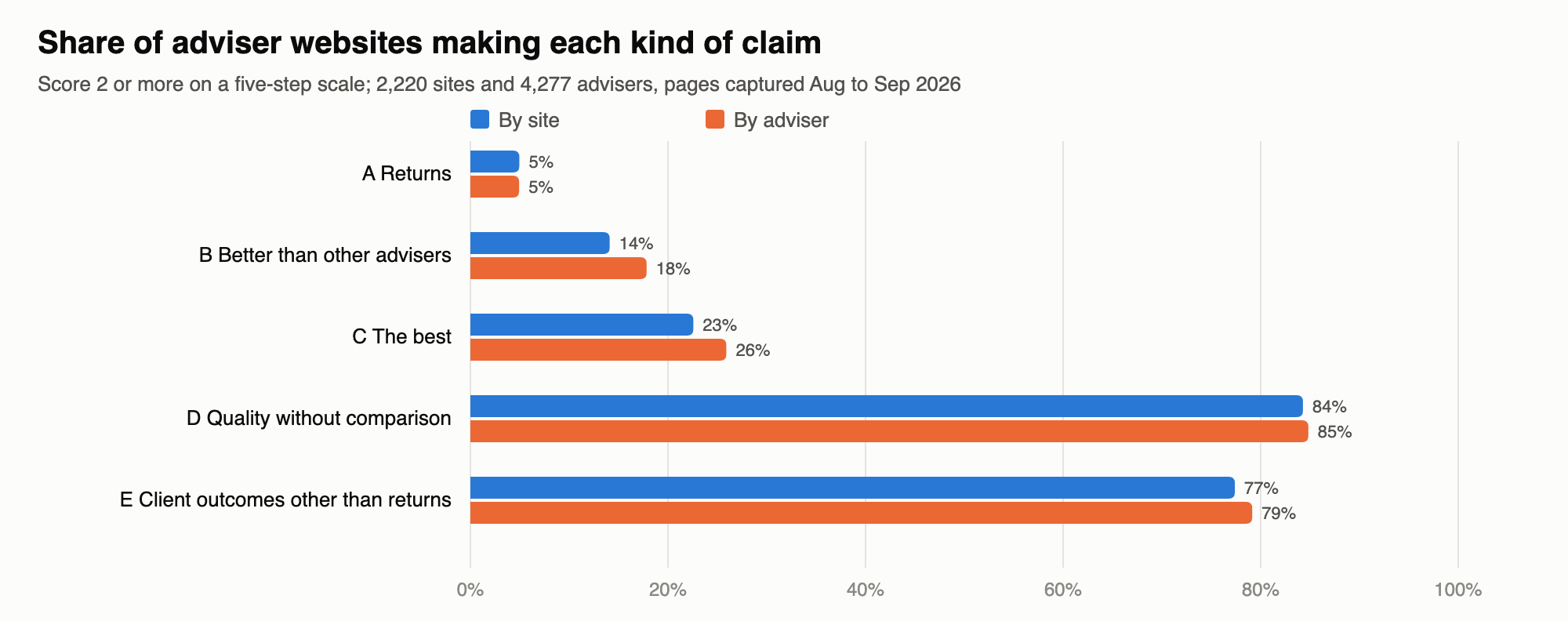
Table T8. Share with a claim (score 2 or more; see part 2.3 just above for an explanation of 'score')
| Dimension | Sites | Share of sites | 95% interval (sites) | Advisers | Share of advisers |
|---|---|---|---|---|---|
| A Returns | 110 of 2,220 | 5.0% | 4.1 to 5.9 | 211 of 4,277 | 4.9% |
| B Better than other advisers | 313 of 2,220 | 14.1% | 12.7 to 15.6 | 763 of 4,277 | 17.8% |
| C The best | 501 of 2,220 | 22.6% | 20.9 to 24.4 | 1,108 of 4,277 | 25.9% |
| D Quality without comparison | 1,871 of 2,220 | 84.3% | 82.7 to 85.7 | 3,628 of 4,277 | 84.8% |
| E Client outcomes other than returns | 1,718 of 2,220 | 77.4% | 75.6 to 79.1 | 3,385 of 4,277 | 79.1% |
The interval is Wilson's (one of a number of alternative ways to calculate a confidence interval, showing the most likely range that contains the true value, i.e. the calculated value is 5.0% but the true value is likely between 4.1% and 5.9%).
Table T7a. Highest score per site, by site (n = 2,220), showing the strength with which the claim is made
| Dimension | Score 0 | Score 1 | Score 2 | Score 3 | Score 4 |
|---|---|---|---|---|---|
| A Returns | 1,350 (60.8%) | 760 (34.2%) | 33 (1.5%) | 68 (3.1%) | 9 (0.4%) |
| B Better than other advisers | 1,507 (67.9%) | 400 (18.0%) | 110 (5.0%) | 170 (7.7%) | 33 (1.5%) |
| C The best | 1,276 (57.5%) | 443 (20.0%) | 215 (9.7%) | 209 (9.4%) | 77 (3.5%) |
| D Quality without comparison | 152 (6.8%) | 197 (8.9%) | 79 (3.6%) | 1,167 (52.6%) | 625 (28.2%) |
| E Client outcomes other than returns | 197 (8.9%) | 305 (13.7%) | 85 (3.8%) | 784 (35.3%) | 849 (38.2%) |
Table T7b. Highest score per adviser, by adviser (n = 4,277)
| Dimension | Score 0 | Score 1 | Score 2 | Score 3 | Score 4 |
|---|---|---|---|---|---|
| A Returns | 2,579 (60.3%) | 1,487 (34.8%) | 57 (1.3%) | 143 (3.3%) | 11 (0.3%) |
| B Better than other advisers | 2,828 (66.1%) | 686 (16.0%) | 210 (4.9%) | 498 (11.6%) | 55 (1.3%) |
| C The best | 2,455 (57.4%) | 714 (16.7%) | 376 (8.8%) | 607 (14.2%) | 125 (2.9%) |
| D Quality without comparison | 253 (5.9%) | 396 (9.3%) | 207 (4.8%) | 2,420 (56.6%) | 1,001 (23.4%) |
| E Client outcomes other than returns | 327 (7.6%) | 565 (13.2%) | 173 (4.0%) | 1,573 (36.8%) | 1,639 (38.3%) |
Jev rarely gives a score of 2 but scores most clear claims at 3.
Claims of higher returns are rare: 5 per cent of websites make such a claim. Most websites score 1 on dimension A. They mention investment advice but make no claim about results. When a website promises higher returns, it rarely backs up this claim. Of the 110 websites with an A claim, 39 quote a figure and 18 cite a source for it.
The question regarding figures refers to any information on investment results: "a percentage return, a dollar sum gained, or a performance ranking". It does not ask whether the page links the figure to a claim about returns. Consequently, the figure flag is also set for 38 websites that do not contain an A claim. A reviewer read the 47 pages behind these websites. Twenty-seven contain forecasts, market movements, index history, examples relating to superannuation or tax, or product returns. Thirteen contain ranking terminology and seven provide details on assets under management. The research page cites the figures from the websites that include a return claim. Of these 110 websites, 39 provide a figure and 18 cite a source.
Table T9. Performance or returns claims (A)
| Unit | All | Figure given, all | Source given, all | With a performance (A) claim (2+) |
|---|---|---|---|---|
| Sites | 2,220 | 77 (3.5%) | 50 (2.3%) | 110 |
| Pages | 8,967 | 101 (1.1%) | 65 (0.7%) | 163 |
Of the 110 sites with a returns claim, 39 (35.5%) quote a figure and 18 (16.4%) cite a source.
A figure or a source counts where Jev's probability is 0.5 or more. A site counts where any page does. The figure question asks for any figure about investment results, a performance ranking included. It does not ask for a returns claim.
Four examples of returns claims: "Based on the SuperRatings 10-year comparison to 30 June 2025, we've delivered investment returns above and beyond the average super fund." "How holistic financial planning can add at least 5.6% per year in structural value to your wealth." "In the last 12 months, the average annual upside of our clients financial plans was $71,203 after financial advice fees." "Advisers generate an average 5.2 per cent extra cash per year for clients regardless of market movements, through services such as asset allocation and behavioural coaching, new research has revealed."
One site in seven compares itself with other advisers: 14 per cent of all sites. By adviser the share is 18 per cent. The usual form is a short phrase, such as "sets us apart", "unlike many" or "different from other". In the ten examples of part 6, the comparison is with most advisers, big firms, institutions or banks. None names a rival.
About one site in five uses a superlative or an honour: 23 per cent of sites, 26 per cent of advisers. The commonest forms are lists and awards: "top financial advisers", "adviser of the year", "one of Australia's top".
This claim is nearly universal. 84 per cent of sites describe the adviser as good without a comparison. Most make the claim under its own heading or in the opening (a score of 3 or 4). Experience is the commonest vehicle: "years of experience" and "extensive experience" lead the phrases.
77 per cent of sites promise a benefit other than returns. "Peace of mind" appears in the evidence of 543 sites. "Financial security", "financial freedom" and "financial goals" follow. The promise is often the page's central message: 38 per cent of sites score 4.
"Independent" is a restricted word under section 923A of the Corporations Act 2001.
Jev's confidence varies on this question. Of the 489 pages answered "claims to be independent", 106 are below 0.6 confidence.
Table T10. Independence, as scored
A site or adviser takes the first class found on any of its pages, in the order of the rows.
| Class | Sites, as scored | Sites, floor | Advisers, as scored | Advisers, floor | Pages, as scored | Pages, floor |
|---|---|---|---|---|---|---|
| Claims to be independent | 11.8% | 9.1% | 9.7% | 6.9% | 457 | 359 |
| Independently owned, not aligned | 11.6% | 13.1% | 14.2% | 15.2% | 597 | 637 |
| States it is not independent | 23.5% | 23.9% | 23.8% | 24.7% | 900 | 903 |
| Silent | 53.1% | 53.9% | 52.3% | 53.2% | 7,013 | 7,068 |
68 of the 2,220 websites in the study have one page that claims independence and another that states it is not independent. Often the second page is the FSG.
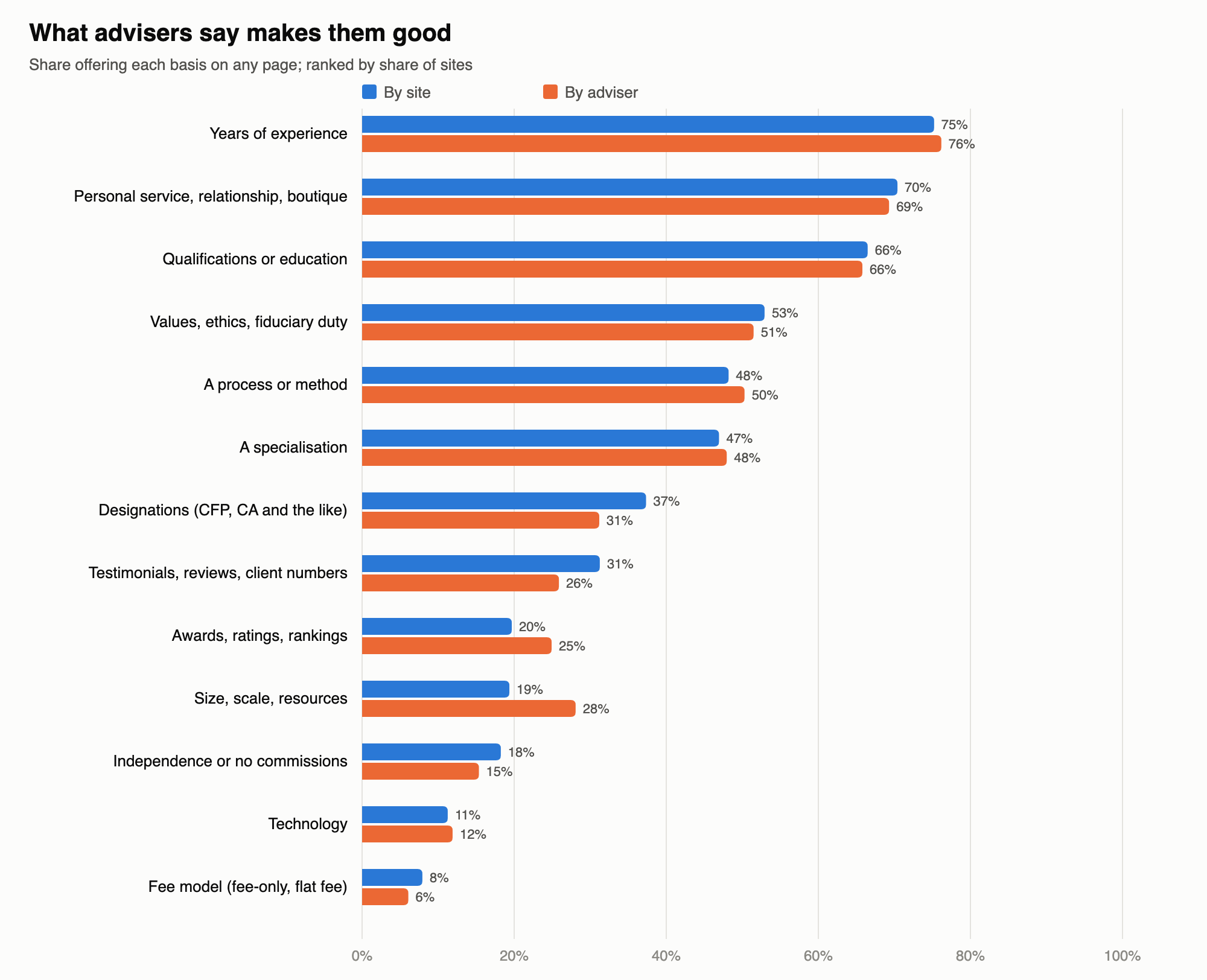
Table T11. The characteristics offered, ranked by share of sites
| Rank | Characteristic | Sites | Share of sites | Advisers | Share of advisers |
|---|---|---|---|---|---|
| 1 | Years of experience | 1,670 | 75.2% | 3,258 | 76.2% |
| 2 | Personal service, relationship, boutique | 1,563 | 70.4% | 2,964 | 69.3% |
| 3 | Qualifications or education | 1,476 | 66.5% | 2,814 | 65.8% |
| 4 | Values, ethics, fiduciary duty | 1,175 | 52.9% | 2,202 | 51.5% |
| 5 | A process or method | 1,070 | 48.2% | 2,151 | 50.3% |
| 6 | A specialisation | 1,042 | 46.9% | 2,051 | 48.0% |
| 7 | Designations (CFP, CA and the like) | 829 | 37.3% | 1,334 | 31.2% |
| 8 | Testimonials, reviews, client numbers | 694 | 31.3% | 1,107 | 25.9% |
| 9 | Awards, ratings, rankings | 437 | 19.7% | 1,066 | 24.9% |
| 10 | Size, scale, resources | 430 | 19.4% | 1,201 | 28.1% |
| 11 | Independence or no commissions | 405 | 18.2% | 657 | 15.4% |
| 12 | Technology | 250 | 11.3% | 509 | 11.9% |
| 13 | Fee model (fee-only, flat fee) | 176 | 7.9% | 260 | 6.1% |
| None offered | 218 | 9.8% | 381 | 8.9% |
The top four characteristics are all personal ones: years of experience, personal service, qualifications and values. Method and specialisation follow, on about half the sites. Outside endorsement is less common. Testimonials appear on 31 per cent of sites, and awards on 20 per cent. A fee model (fee-only, flat fee) is the rarest basis, at 8 per cent.
Every table in this part counts advisers, not sites.
Table T12. By licensee size band (current advisers on the licence)
Cells are the share of advisers in the group with a claim (score 2 or more). The last column is the share whose pages claim independence, as scored.
| Group | n | Licensees | Largest licensee's share | A returns | B better | C best | D quality | E outcomes | Claims independent |
|---|---|---|---|---|---|---|---|---|---|
| 1 | 178 | 178 | 0.6% | 5.6% | 16.9% | 11.8% | 79.2% | 64.6% | 19.1% |
| 2 to 3 | 389 | 278 | 0.8% | 6.2% | 14.4% | 18.5% | 76.3% | 69.2% | 10.5% |
| 4 to 10 | 720 | 300 | 1.0% | 5.4% | 13.9% | 24.2% | 86.2% | 75.1% | 11.4% |
| 11 to 20 | 327 | 70 | 3.4% | 6.1% | 19.9% | 34.6% | 84.4% | 79.8% | 15.0% |
| 21 to 50 | 566 | 61 | 7.2% | 2.1% | 18.2% | 24.9% | 82.7% | 76.1% | 10.1% |
| 51 to 100 | 589 | 23 | 10.0% | 8.5% | 6.3% | 16.0% | 83.0% | 85.6% | 10.7% |
| 101 to 500 | 1,507 | 23 | 16.3% | 3.7% | 24.7% | 32.7% | 88.6% | 83.8% | 6.0% |
| Not recorded | 1 | 1 | 100.0% | 0.0% | 0.0% | 0.0% | 100.0% | 100.0% | 0.0% |
| All | 4,277 | 934 | 5.8% | 4.9% | 17.8% | 25.9% | 84.8% | 79.1% | 9.7% |
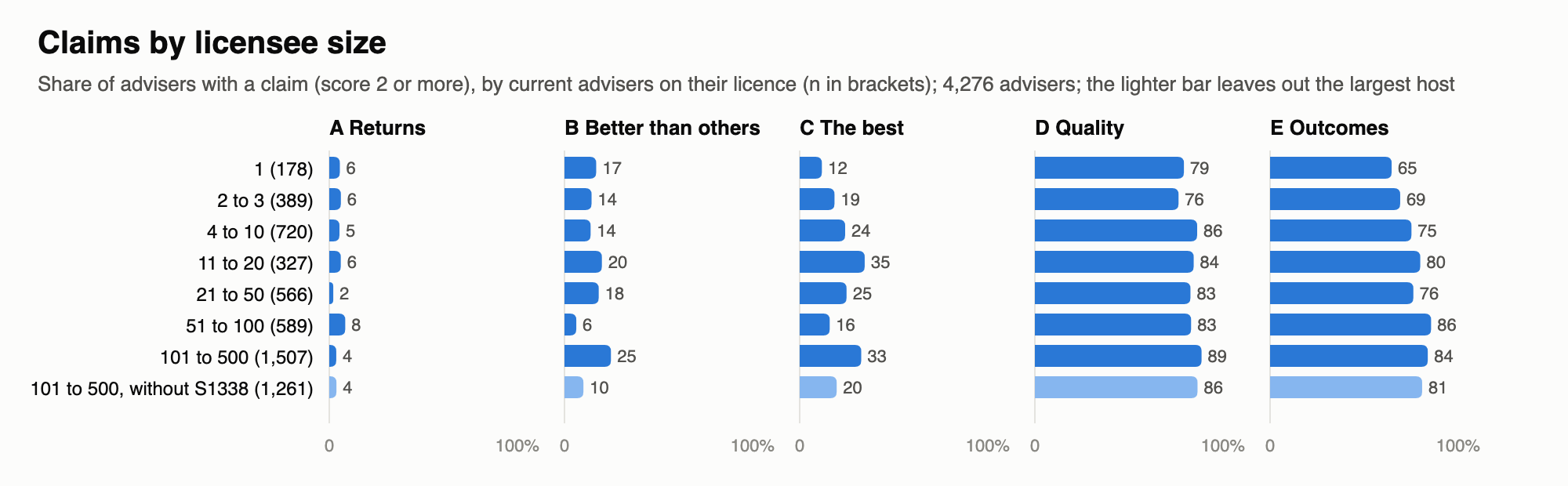
The large bands hold few licensees. In the band of 101 to 500, 23 licensees hold 5,027 current advisers; 1,507 of them are in the study as they have a website.
Table T13. By highest qualification (AQF level)
Cells are the share of advisers in the group with a claim (score 2 or more). The last column is the share whose pages claim independence, as scored.
| Group | n | A returns | B better | C best | D quality | E outcomes | Claims independent |
|---|---|---|---|---|---|---|---|
| 9 or 10: master's or doctorate | 749 | 7.2% | 18.3% | 28.7% | 86.5% | 81.6% | 13.2% |
| 8: graduate diploma or certificate | 1,453 | 4.2% | 18.6% | 25.7% | 86.0% | 80.2% | 8.0% |
| 7: bachelor degree | 1,450 | 4.1% | 17.9% | 26.0% | 84.1% | 78.3% | 10.2% |
| 6: advanced diploma | 250 | 3.2% | 12.0% | 18.8% | 79.2% | 78.4% | 5.6% |
| 5 or below: diploma or Certificate IV | 311 | 7.7% | 17.7% | 24.8% | 83.3% | 74.0% | 10.9% |
| Not recorded | 64 | 6.2% | 17.2% | 28.1% | 84.4% | 75.0% | 7.8% |
Advisers at master's or doctorate level claim independence more often: 13 per cent, against 6 to 11 per cent at the other levels. Advisers at advanced diploma level (AQF 6) make fewer comparative and superlative claims. Their shares are 12 per cent on B and 19 per cent on C. At bachelor level and above, the shares are 18 to 19 per cent on B and 26 to 29 per cent on C.
Table T14. By state
Cells are the share of advisers in the group with a claim (score 2 or more). The last column is the share whose pages claim independence, as scored.
| Group | n | A returns | B better | C best | D quality | E outcomes | Claims independent |
|---|---|---|---|---|---|---|---|
| NSW | 1,220 | 5.1% | 16.7% | 24.9% | 87.0% | 80.3% | 11.6% |
| VIC | 1,175 | 4.3% | 16.3% | 25.4% | 84.9% | 78.9% | 9.4% |
| QLD | 925 | 6.9% | 22.1% | 29.1% | 85.2% | 80.9% | 7.7% |
| WA | 425 | 2.1% | 18.8% | 27.3% | 79.5% | 75.1% | 8.9% |
| SA | 348 | 4.3% | 12.4% | 19.3% | 82.8% | 75.9% | 8.9% |
| ACT | 87 | 5.7% | 19.5% | 29.9% | 90.8% | 80.5% | 20.7% |
| TAS | 77 | 3.9% | 18.2% | 23.4% | 76.6% | 76.6% | 6.5% |
| NT | 13 | 7.7% | 53.8% | 61.5% | 92.3% | 84.6% | 0.0% |
| Not recorded | 7 | 14.3% | 28.6% | 28.6% | 85.7% | 100.0% | 14.3% |
Among the five larger states, B ranges from 12 per cent (SA) to 22 per cent (QLD). C ranges from 19 per cent (SA) to 29 per cent (QLD). The Northern Territory (13 advisers) and the advisers with no state (7) are too few to read.
Table T15. CFP holders against the rest (register designations)
Cells are the share of advisers in the group with a claim (score 2 or more). The last column is the share whose pages claim independence, as scored.
| Group | n | A returns | B better | C best | D quality | E outcomes | Claims independent |
|---|---|---|---|---|---|---|---|
| CFP holders | 1,122 | 4.6% | 17.3% | 27.3% | 87.7% | 78.4% | 13.5% |
| All others | 3,155 | 5.0% | 18.0% | 25.4% | 83.8% | 79.4% | 8.4% |
| All | 4,277 | 4.9% | 17.8% | 25.9% | 84.8% | 79.1% | 9.7% |
CFP holders and the rest differ by 2 points or less on A, B, C and E. CFP holders claim quality (D) 4 points more often, and independence 5 points more often (13.5 against 8.4 per cent).
Table T16. Web pages against FSGs (pages in the findings)
| Kind | Pages | A | B | C | D | E | Claims independent | Independently owned | Not independent |
|---|---|---|---|---|---|---|---|---|---|
| Web pages | 7,471 | 2.0% | 6.0% | 13.4% | 70.7% | 68.0% | 5.4% | 7.0% | 0.9% |
| FSGs (PDF) | 1,496 | 0.8% | 1.5% | 4.9% | 43.9% | 27.5% | 3.8% | 5.1% | 55.5% |
Claims sit mostly on web pages. The FSG is where the adviser states that it is not independent: 55 per cent of FSGs do. The FSG figures are understated, because 40 FSGs gave no text to read (part 7).
Table T17. Example evidence sentences
Ten per dimension, from the highest scores, one per site. Sites are named by index number only.
A Returns
| Site | Kind | Score | Position | Sentence |
|---|---|---|---|---|
| S434 | web | 4 | opening | The investments used include managed funds, listed securities and stocks on the Australian and US Stock market and direct property which actually grow over time with measurable results, as opposed to sideways trending for 20 years and getting nowhere! |
| S524 | web | 4 | body | Based on the SuperRatings 10-year comparison to 30 June 2025, we've delivered investment returns above and beyond the average super fund.^ |
| S150 | web | 4 | opening | Advisers generate an average 5.2 per cent extra cash per year for clients regardless of market movements, through services such as asset allocation and behavioural coaching, new research has revealed. |
| S1831 | web | 4 | body | Reduce your body corporate fees and improve the value of your property by having us improve the returns of your sinking fund. |
| S1581 | web | 4 | body | Today, our clients enjoy the benefits of this knowledge as we have fine tuned our strategies to ensure our clients’ losses are limited in the event of a major sharemarket correction. |
| S2112 | web | 4 | opening | How holistic financial planning can add at least 5.6% per year in structural value to your wealth. |
| S720 | web | 4 | opening | Great financial advice works like fertiliser for your money – multiplying your assets and accelerating growth. |
| S943 | web | 4 | headline | Retire Early on $120k passive income a year without ever worrying about money again |
| S1187 | web | 4 | opening | Boost your future revenue with our exclusive e-book and unveil the strategies that can supercharge your wealth-building journey. |
| S1535 | web | 3 | body | In the last 12 months, the average annual upside of our clients financial plans was $71,203 after financial advice fees. |
B Better than other advisers
| Site | Kind | Score | Position | Sentence |
|---|---|---|---|---|
| S1463 | web | 4 | opening | Approximately 2% of financial advisers in Australia are declared independent; the vast majority are affiliated with large banks or institutions, have in-house products, or receive commissions. |
| S701 | web | 4 | body | Most financial advisers disappear after theyʼve sold you something. |
| S1144 | web | 4 | opening | We Offer A Personal Touch That the Big Firms Don’t. |
| S2179 | web | 4 | body | aren’t institutional financial planners with sales targets to meet. |
| S1212 | web | 4 | body | This is achieved through a relaxed and personal approach which sets us apart and allows us to focus on the things that really matter to you. |
| S1535 | web | 4 | opening | Most financial advice is cautious, generic, and focused on not stuffing it up, not on getting you ahead. |
| S1514 | web | 4 | opening | In Australia less than 2% of Financial Advisers can call themselves independent. |
| S1203 | web | 4 | opening | A key aspect of what sets us apart is that we have in-house investment research and portfolio construction capabilities. |
| S1696 | web | 4 | opening | Unlike generic managed fund solutions, our team of qualified financial planners provides tailored advice that aligns with your buildings financial goals. |
| S339 | web | 4 | opening | We’re not your typical financial advisers. |
C The best
| Site | Kind | Score | Position | Sentence |
|---|---|---|---|---|
| S166 | web | 4 | opening | has been named as one of the Barron's top 100 Financial Advisers for 2022. |
| S241 | web | 4 | opening | 2019 Financial Services Partners ‘’Rising Star Award” |
| S122 | web | 4 | opening | has been named one of Australia’s top 100 financial advisers. |
| S968 | web | 4 | opening | We are honoured that our clients have repeatedly voted us number one for client service. |
| S1227 | web | 4 | body | As the best financial planners on the Sunshine Coast, we understand that when it comes to retiring there are no second chances to rebuild your wealth. |
| S1922 | web | 4 | body | When you’re seeking expertise in financial planning, it’s hard to do better than someone featured in the FSPOWER50! |
| S1499 | web | 4 | headline | Award-winning f inancial advisors in Sydney |
| S1285 | web | 4 | opening | Barron’s Top 150 Financial Advisers in Australia |
| S441 | web | 4 | body | Enjoy Financial Security With The Best Financial Advisers Near You |
| S1831 | web | 4 | body | We also have a keen understanding of market dynamics that hasn’t only distinguished us as the industry leader in body corporate investment, but has also positioned us as Brisbane’s most trusted service for anyone seeking unparalleled expertise in managing body corporate assets. |
D Quality without comparison
| Site | Kind | Score | Position | Sentence |
|---|---|---|---|---|
| S780 | web | 4 | opening | Get the best advice and make sure that your family's aged care experience is as stress free as possible. |
| S646 | web | 4 | headline | Expert Financial Planners Sydney & Canberra |
| S1610 | web | 4 | body | to ongoing excellence in providing personal financial advice, robust and high quality advice processes and a clear and demonstrable passion for |
| S2096 | web | 4 | opening | We’re experts in our field, and it’s our mission to get you results. |
| S224 | web | 4 | headline | Secure Your Future with Honest, Expert Financial Advice |
| S1301 | web | 4 | opening | His commitment to excellence is evident in his qualifications, holding both the Diploma in Financial Advising and the Advanced Diploma in Financial Planning. |
| S1056 | web | 4 | opening | We partner with you to deliver expert advice that’s centred on achieving what matters most to you today and through every stage of your life. |
| S716 | FSG | 4 | opening | QUALITY FINANCIAL ADVICE HELPING YOU CREATE, MANAGE & PROTECT YOUR WEALTH We all lead busy lives. |
| S1434 | web | 4 | opening | Count on us - we're the experts in our field. |
| S1285 | web | 4 | opening | Based on key quantitative factors—including client assets under management, revenue generated, and overall business quality—this recognition is an objective benchmark of excellence within the industry. |
E Client outcomes other than returns
| Site | Kind | Score | Position | Sentence |
|---|---|---|---|---|
| S1970 | web | 4 | opening | Enjoy greater peace-of-mind, experience less stress and do better financially. |
| S553 | web | 4 | opening | We believe everyone deserves to live they lifestyle they want, without having to worry about money. |
| S1701 | web | 4 | opening | If you want to look ahead to the future with confidence, it’s important to have an adviser who can help you to diagnose any weaknesses in your current financial arrangements and guide you towards a healthier financial future. |
| S1203 | web | 4 | headline | Clients come to us for peace of mind financial solutions |
| S1871 | web | 4 | opening | We are passionate about helping you to achieve Financial Freedom. |
| S430 | web | 4 | body | Our goal is simple: to help you feel financially secure, reduce financial stress, and enjoy the freedom to spend more time doing the things you love with the people who matter most. |
| S351 | web | 4 | opening | I can help you navigate the complexities of managing your finances during this exciting phase of life and help you achieve peace of mind about your future. |
| S1830 | web | 4 | opening | You can look forward to a more secure financial future. |
| S1018 | web | 4 | opening | The goal is obtaining financial security to live your life on your own terms.’ |
| S611 | web | 4 | opening | Whether for you it means have time to be there for your kids, travel around the world with loved ones, donating money to charity, paying off your mortgage or planning for a comfortable retirement, anyone can create true financial freedom for themselves. |
Coverage. 4,429 of the 15,179 current advisers on the September 2026 register extract have a site read (29 per cent). After the exclusion of non-practices, the findings cover 4,277 advisers (28 per cent) on 2,220 sites. The study leaves out advisers with no website found, and advisers whose pages failed an identity check. Advisers with a website may differ from those without one.
Capture dates. The pages were captured from 27 August to 26 September 2026. A site may have changed since.
Clipping. Jev read at most 12,000 characters. It clipped 436 web pages (5.8 per cent). For 393 longer FSGs, it read only the opening and the restricted-word windows. A claim late on a long page may be missed.
Empty pages. 45 pages gave no parseable text at all: 40 FSGs and 5 web pages. 123 pages gave under 200 characters. These are probably scanned PDFs and pages built by script. They score 0. They are 0.5 per cent of all pages but 2.7 per cent of FSGs.
8,967 pages from 2,220 Australian adviser websites, captured August to September 2026, scored by the TypeSafe model jev-1.13.0.
Table T19. The shares, for citing
2,220 adviser websites (sites) and 4,277 advisers, captured August and September 2026.
| Claim | Share of sites | Share of advisers |
|---|---|---|
| Returns (A) | 5.0% | 4.9% |
| Better than other advisers (B) | 14.1% | 17.8% |
| The best (C) | 22.6% | 25.9% |
| Quality without comparison (D) | 84.3% | 84.8% |
| Client outcomes other than returns (E) | 77.4% | 79.1% |
| Claims independence (as scored) | 11.8% | 9.7% |
| Claims independence (0.6 floor) | 9.1% | 6.9% |
| Gives a figure, among sites with a returns claim | 39 of 110, 35.5% | n/a |
| Gives a source, among sites with a returns claim | 18 of 110, 16.4% | n/a |
| Any figure for investment results on the site | 3.5% | n/a |
| Any source for such a figure on the site | 2.3% | n/a |
Table T18. The commonest phrasings per dimension
Phrases of two to four words in the evidence sentences, counted once per site; at least 3 sites. Phrases made only of trade words (financial planning, wealth management) are left out.
A Returns: "investment returns" (5); "investment strategies" (4); "investment portfolios" (4); "investment portfolio" (4); "investment strategy" (4); "strong returns" (4); "consistently delivered" (3); "maximise your returns" (3); "maximise returns" (3); "maximum returns" (3); "year after year" (3); "track record" (3)
B Better than other advisers: "sets us apart" (34); "other financial" (20); "unlike many" (12); "many financial" (9); "other financial planners" (8); "different from other" (8); "financial advisory" (8); "many other" (8); "makes us different" (7); "advisory firms" (7); "unlike other" (7); "stand out" (7)
C The best: "top financial" (51); "adviser of the year" (48); "one of australia's" (46); "leading financial" (44); "best financial" (38); "top financial advisers" (30); "australia's top" (30); "award winning" (27); "australia's leading" (24); "advisers in australia" (22); "year award" (22); "one of australia's top" (20)
D Quality without comparison: "years experience" (234); "years of experience" (205); "certified financial" (170); "experience in the financial" (134); "retirement planning" (110); "experienced financial" (97); "experience in financial" (96); "financial goals" (96); "extensive experience" (94); "quality advice" (86); "highly qualified" (82); "high quality" (82)
E Client outcomes other than returns: "peace of mind" (543); "financial future" (252); "financial security" (215); "financial goals" (194); "financial freedom" (184); "helping clients" (117); "achieve financial" (111); "financial decisions" (101); "clients achieve" (100); "help you achieve" (75); "feel confident" (75); "achieve their financial" (72)
In this section, a question is put to certification bodies and providers of degree programmes in the field of financial planning: Do they claim that holders offer benefits to their clients? And what evidence do they provide to support this?
The corpus comprises 47 lines, one per page or page section, all of which were collected on 11 October 2026. 42 pages were read and assessed. Five pages could not be assessed: these are listed in section 9.8, along with the respective reasons.
Each page was assessed manually on the basis of the five dimensions set out in part 2. Jev was not used, and no model was invoked. The subject of each assessment is the qualification:
The scale is the one in part 2. A 0 means no claim and 1 a passing mention. A 2 is a clear claim made once. A 3 is a claim repeated or under its own heading, and 4 is the page's central message.
Five scoring conventions apply throughout:
Each score is the highest that body or provider reached on any of its pages, on the five-step scale of part 2.3: 0 means no such claim, 1 a passing mention, 2 a clear claim made once, 3 a clear claim repeated or under its own heading, and 4 the page's central message. The FAAA's CFP pages come first.
| Body or provider, credential | Pages | A | B | C | D | E | Evidence cited | Independent of the body |
|---|---|---|---|---|---|---|---|---|
| FAAA, CFP | 8 | 2 | 3 | 4 | 3 | 4 | Value of Advice survey, 2024 and 2025 | no |
| FAAA, Aged Care Specialist | 1 | 0 | 0 | 0 | 3 | 0 | none | n/a |
| Aged Care Steps, Accredited Aged Care Professional | 4 | 0 | 1 | 2 | 3 | 4 | none (two adviser case studies, an industry award) | n/a |
| Chartered Accountants ANZ, CA | 4 | 0 | 3 | 1 | 2 | 4 | none | n/a |
| CPA Australia, CPA | 3 | 0 | 2 | 2 | 3 | 3 | none | n/a |
| SMSF Association, SSA | 3 | 0 | 2 | 3 | 3 | 2 | none | n/a |
| CFA Institute, CFA | 2 | 1 | 2 | 4 | 3 | 3 | none (testimonials) | n/a |
| Actuaries Institute, Fellow | 3 | 0 | 0 | 3 | 3 | 3 | none | n/a |
| STEP Canada (substitute for STEP), TEP | 3 | 0 | 2 | 2 | 3 | 3 | none | n/a |
| Kaplan Professional, degrees | 2 | 0 | 3 | 3 | 2 | 0 | none | n/a |
| Griffith University | 1 | 0 | 0 | 2 | 3 | 3 | none | n/a |
| Deakin University | 2 | 0 | 0 | 1 | 2 | 0 | none | n/a |
| RMIT University | 1 | 1 | 0 | 0 | 2 | 3 | none | n/a |
| University of the Sunshine Coast | 1 | 0 | 0 | 0 | 1 | 0 | none | n/a |
| Curtin University | 1 | 0 | 0 | 2 | 2 | 3 | none (job projections, not client benefit) | n/a |
| Charles Sturt University | 1 | 0 | 1 | 0 | 2 | 2 | none | n/a |
| Western Sydney University | 1 | 0 | 0 | 0 | 1 | 0 | none | n/a |
| University of Wollongong | 1 | 0 | 0 | 0 | 1 | 0 | none | n/a |
Five pages have no score: STEP, the University of South Australia, Finsia, Deakin's Master of Financial Planning page, and LRS. Section 9.8 gives the reasons.
Four patterns stand out.
| Page | Kind | A | B | C | D | E | Evidence |
|---|---|---|---|---|---|---|---|
| https://faaa.au/cfp-certification/ | for advisers | 0 | 3 | 4 | 3 | 3 | Value of Advice research, named as a benefit to holders |
| https://faaa.au/find-a-planner/ | for consumers | 0 | 0 | 1 | 2 | 0 | none |
| https://faaa.au/betteroff-campaign/ | for consumers (campaign copy) | 0 | 1 | 2 | 2 | 4 | Value of Advice 2024, by asterisk |
| https://faaa.au/financial-planning/faqs/ | for consumers | 0 | 2 | 2 | 3 | 3 | none |
| https://www.moneyandlife.com.au/ | for consumers (FAAA site) | 0 | 0 | 0 | 2 | 4 | none |
| https://faaa.au/value-of-advice-research/ | research hub | 0 | 0 | 0 | 0 | 4 | the reports themselves |
| https://faaa.au/wp-content/uploads/2025/09/Value-of-Advice-2025.pdf | research | 2 | 3 | 0 | 2 | 4 | the survey itself |
| https://faaa.au/wp-content/uploads/2024/09/FAAA-Value-of-Advice-2024-Report.pdf | research | 2 | 3 | 0 | 2 | 4 | the survey itself |
The CFP certification page carries the strongest superlatives in the corpus:
The consumer FAQ makes the superlative to the public:
The consumer pages mostly speak of FAAA members, not of CFP holders alone. The "Better off" campaign is the main example:
One quote per dimension scored 2 or more, at the body's highest score. The CSV holds every quote.
Aged Care Steps, Accredited Aged Care Professional (all pages are written for advisers)
FAAA, Aged Care Specialist
Chartered Accountants ANZ, CA
CPA Australia, CPA
SMSF Association, SSA
CFA Institute, CFA (no page for retail investors was found; the employer page stands in)
Actuaries Institute, Fellow (pages addressed to organisations)
STEP Canada, TEP (a substitute: STEP's global and Australian pages could not be fetched)
Kaplan Professional
Griffith University
Other universities
The University of the Sunshine Coast, Western Sydney University and the University of Wollongong state accreditation only. Each scores 1 on D and 0 elsewhere.
The FAAA cites one source for a client benefit: its annual Value of Advice research. The research hub says the series began in 2022. The 2024 and 2025 reports were read in full.
Who ran it. MYMAVINS ran the survey. Both reports describe it as an "independent research firm". The research hub also calls the work "independent research".
Who paid. Both reports say the FAAA commissioned the research. The reports also state that the FAAA is the marks licensing authority for the CFP marks in Australia. Neither report states the cost.
The sample.
| 2024 report | 2025 report | |
|---|---|---|
| Fieldwork | August to September 2024 | July to August 2025 |
| Mode | online survey | online survey |
| Respondents | 1,193 | 1,226 |
| Eligibility | over 25; earning over $90,000 a year or holding over $50,000 in investable assets | the same |
| Advised | working with an adviser now, seeking advice as needed, or advised in the past three years | the same |
| Unadvised | never advised, or last advised more than three years ago | the same |
| CFP group | clients of a CFP professional, a subset of the advised | the same |
Neither report states how many respondents were clients of a CFP professional. Neither report states how respondents were recruited, whether results were weighted, or any margin of error for the CFP comparisons.
What it measured. The FAAA Value of Advice Index has four components, each scored from 0 to 100:
The CFP results. The reports publish a "CFP Professional Delta". For three components, it compares CFP clients with the unadvised. Only for Experience does it compare CFP clients with the clients of other advisers. The last column below subtracts the published scores, to show the gap between CFP clients and other advisers' clients.
| Component | Year | Unadvised | Advised, not CFP | CFP clients | Published CFP Delta | CFP clients minus other advised |
|---|---|---|---|---|---|---|
| Quality of life | 2025 | 62 | 71 | 76 | +14 | +5 |
| Financial confidence | 2025 | 57 | 70 | 76 | +19 | +6 |
| Financial satisfaction | 2025 | 55 | 69 | 77 | +22 | +8 |
| Experience | 2025 | n/a | 76 | 86 | +10 | +10 |
| Quality of life | 2024 | 62 | 71 | 77 | +14 | +6 |
| Financial confidence | 2024 | 57 | 70 | 75 | +18 | +5 |
| Financial satisfaction | 2024 | 55 | 69 | 75 | +20 | +6 |
| Experience | 2024 | n/a | 74 | 84 | +11 | +10 |
The reports also state proportions. In 2025, "close to 7 in 10 of those advised by a CFP professional are highly satisfied with their overall wealth compared to less than 1 in 3 of those who are unadvised". In 2024, more than 4 in 5 CFP clients agreed their financial security had improved since their first advice. Close to 7 in 10 clients of other advisers agreed.
What this design can show. It shows what these respondents reported during those months. CFP clients in the sample gave higher ratings than other clients receiving advice and than those not receiving advice. The survey repeats this pattern over a two-year period.
What it cannot show. It cannot show that the CFP was the cause of the higher ratings. Four features of the study design stand in the way of this:
How the FAAA uses it. The CFP certification page offers the research to future holders as a marketing asset: "Benefit from high public awareness of the CFP trademark, our Better off campaign and annual Value of Advice research". The "Better off" campaign page cites the 2024 report for its claim that advice brings "a higher quality of life" and "less financial stress".
Every statement below was checked against the four published editions on 12 October 2026. The 2022 edition was commissioned by the FPA, the FAAA's predecessor. The 2023 edition was part of the FPSB's global study. The 2024 and 2025 editions were commissioned by the FAAA. All four were run by the research firm MYMAVINS.
An online survey of Australians, which has been conducted annually since 2022. The 2024 survey involved 1,193 respondents, while the 2025 survey involved 1,226. Respondents had to be over 25 years of age and either earn more than $90,000 a year or have investable assets of more than $50,000. The 2022 survey focused on Australians aged 40 and over. Respondents are divided into three groups: those without financial advice, those advised by a CFP professional, and those advised by someone else. Each group is assessed using four indices: self-assessed quality of life, financial confidence, financial satisfaction and experiences with advice. The reports publish the group results and the differences between them.
The reports specify the dates of the fieldwork, the number of respondents, the eligibility criteria, and the definitions of the terms "advised" and "not advised". The 2022 edition also states the group sizes: 212 people advised by a CFP professional, 194 people advised by another person, and 645 people who were not advised. These details are no longer provided in later editions.
The 2022 edition specifies the group sizes. Of the 406 respondents who had received advice, 212 (52%) stated that they had a CFP adviser. Around 3,200 of the approximately 15,000 advisers in Australia hold this qualification, which is roughly one in four. In the archive of advisers' websites used in this study, 26% of advisers hold this qualification. For 52% of the respondents receiving advice to be CFP clients, one of three conditions must apply. CFP professionals have twice as many clients as other advisers. Or the sample favours them in the selection process. Or the respondents are answering the question incorrectly. The report does not address this. Whichever explanation applies, the CFP comparison is based on a group whose composition is uncertain.
The survey can reveal what respondents said about their own lives and finances during the months of fieldwork. It shows the same pattern in every edition: respondents who receive advice rate themselves higher than those who do not, and CFP clients, in turn, rate themselves even higher.
It cannot show that the advice or the CFP certification caused these ratings. Four features of the study design stand in the way of this.
The FAAA's "Better off" campaign relies on the 2024 report to support its claim that financial advice leads to "a higher quality of life" and "less financial stress". On the FAAA's page on CFP certification, the study is presented to prospective holders as a benefit of the certification. The campaign page states that its referrer element was funded by a marketing levy paid by CFP professionals. The FAAA is also the licensing authority for the CFP marks in Australia.
To the author's knowledge this is the only survey that measures the satisfaction of clients of advisers. The idea to measure financial advice outcomes such as satisfaction can be sound but this survey only publishes the total sample size but is curiously silent about any details that would support any statistical validity of the survey.
Hence this survey as published is not able to substantiate any of its claims and the urgent question arises whether these details are not disclosed because they would show that the survey is a marketing exercise and nothing else.
It is not a good sign for an industry if there is only one regular, large survey of advice quality and then this survey fails any quality standard commonly accepted for surveys except for the absolute number of respondents at over 1,000 each time.
If the argument that CFP advisers are better advisers can only be supported by a survey where only one quality indicator is published then this invites the question whether a CFP adviser is in any way a better adviser on average than their non-CFP peers are on average.
An entry counted when its title held "financial planning" or "financial advice" and a degree level: bachelor, master, graduate diploma, doctorate or honours. Graduate certificates, diplomas, single units and designations were left out. Each adviser counts once per provider. Provider names were merged by hand. Kaplan's four names became one, and so did RMIT's three. Finsia was merged with the Securities Institute of Australia, and two universities with their former names.
Repeated, for convenience:
| Score | Meaning |
|---|---|
| 0 | No such claim on the page |
| 1 | A passing or implied mention only |
| 2 | A clear claim, made once, in body text |
| 3 | A clear claim repeated, or under its own heading |
| 4 | The page's central message, in the headline or the opening |
| Rank | Provider | Current advisers | Page scored | A | B | C | D | E |
|---|---|---|---|---|---|---|---|---|
| 1 | Kaplan (Professional and Higher Education) | 4,545 | yes | 0 | 3 | 3 | 2 | 0 |
| 2 | Deakin University | 462 | yes | 0 | 0 | 1 | 2 | 0 |
| 3 | Finsia (with the Securities Institute) | 413 | no live page | |||||
| 4 | Griffith University | 369 | yes | 0 | 0 | 2 | 3 | 3 |
| 5 | RMIT University | 330 | yes | 1 | 0 | 0 | 2 | 3 |
| 6 | University of the Sunshine Coast | 122 | yes | 0 | 0 | 0 | 1 | 0 |
| 7 | Western Sydney University | 107 | yes | 0 | 0 | 0 | 1 | 0 |
| 8 | Curtin University | 78 | yes | 0 | 0 | 2 | 2 | 3 |
| 9 | University of South Australia | 74 | page not found | |||||
| 10 | University of Wollongong | 69 | yes | 0 | 0 | 0 | 1 | 0 |
| 11 | Charles Sturt University | 67 | yes | 0 | 1 | 0 | 2 | 2 |
Kaplan's count is mostly graduate diplomas: 3,875 entries titled Graduate Diploma of Financial Planning, against 804 Master of Financial Planning. Charles Sturt, eleventh, stands in for Finsia and UniSA, which had no page to read.
Every provider page scored was written for students.
LRS (Life Risk Specialist), 67 advisers on the register. The FPA and the AFA merged into the FAAA in April 2023. LRS was an FPA designation, not an AFA one. A 2011 FPA document reported 89 LRS holders. That document now returns an error page; it was read only as a search summary. Treasury's list of approved designations recognised LRS for study completed from 2009 to 2018. The FAAA therefore holds LRS by succession, as an inference. Its Specialist Designations page lists only the Aged Care Specialist designation. A search of the FAAA site found no LRS page. No page about LRS exists to score, and the designation appears closed to new entrants.
The aged care accreditation, 531 advisers in advisers.json. The register's free text names Aged Care Steps' Accredited Aged Care Professional in about 460 current entries. Eight entries name the FAAA Aged Care Specialist designation, and fourteen membership entries name the Accredited Aged Care Professional. Aged Care Steps issues the accreditation only to advisers on the Financial Advisers Register or in a Professional Year. The FAAA's designation is separate and requires the Aged Care Steps programme. The match to the register's AGED_CARE mark is by name only.
Aged Care Steps writes for advisers, not for their clients. It calls its programme "the gold standard in aged care advice training". Its client-outcome claims rest on two case studies of single adviser practices. One says that a team "has seen a significant improvement in their client outcomes". Neither case study reports a measure.
The professional bodies make numerous claims regarding quality and reputation. However, they rarely claim that holders of these qualifications achieve better results for their clients. Only the FAAA offers evidence for a client benefit of such a qualification, in the form of a survey it commissioned. The survey assesses how respondents rate their own lives and financial situations; however, it does not measure investment performance.
The CFP claims also reach students through the degree providers. Kaplan and Griffith repeat the FAAA's "gold standard" and "standard of excellence" wording on their course pages.
Pages not fetched or not found.
Substitutes.
The "Better off" campaign and the CFP levy. The campaign promotes FAAA members to consumers, and cites the FAAA's own survey. Its page states: "Note that the referrer element of the Better off campaign references the CFP designation, as it has been funded from a marketing levy paid by CFP professionals in the past." CFP holders therefore paid for the campaign that promotes the designation.
The independence figures above come from Jev's reading of each page. Because "independent" is a restricted word, a second check read every occurrence of the word stem "independen" with a fixed rule, and sorted them by what the word refers to. Its base is wider than the findings above: all 9,089 distinct archived pages on the 2,322 hosts of the same 4,277 advisers, where the model's run scored 8,967 pages on 2,220 sites. Shares in this part are of the 2,322 hosts. The headline: 1,138 of the 2,322 (49%) use some form of the word. Most of that is boilerplate: the compulsory statement that the adviser is not independent (27%) and the sentence that AFCA offers "fair and independent" dispute resolution (17%). 257 websites (11.1%) use wording that claims independence. Of these, 79 (3.4%) also state that they are not independent, usually in the Financial Services Guide. The other 178 (7.7%) claim and nowhere deny on the pages read; the directory's separate reading of the same websites found a denial on 28 more, which leaves 150 (6.5%). 66 websites (2.8%) use "independently owned" or a variant; Jev's wider class of 13% also counts wordings without the stem, such as "privately owned" and "not aligned with any bank". Whether a claim meets the legal test in section 923A cannot be read from a website. The search-engine reading, that the word is placed for Google rather than for readers, holds for about one claiming website in six: 27 of the 178 carry the claim in the page title, the meta description or the main heading.
Shares are of all 2,322 websites and all 4,277 advisers. "Only category" means the stem is used in no other way on that website or by that adviser.
| What the word refers to | Sites | Share of all sites | Only category on the site | Advisers | Share of all advisers | Only category for the adviser |
|---|---|---|---|---|---|---|
| the adviser claims independence | 257 | 11.1% | 69 | 783 | 18.3% | 92 |
| independently owned or operated (not aligned) | 66 | 2.8% | 13 | 142 | 3.3% | 28 |
| states it is not independent | 617 | 26.6% | 103 | 1573 | 36.8% | 218 |
| a third party described as independent | 536 | 23.1% | 73 | 1691 | 39.5% | 120 |
| the client's financial independence | 187 | 8.1% | 67 | 976 | 22.8% | 160 |
| other uses | 529 | 22.8% | 130 | 1723 | 40.3% | 198 |
The eight most common variations in each category, by website. "Only variation" means no other variation appears on the website or for the adviser.
| Category | Variation | Sites | Only variation on the site | Advisers | Only variation for the adviser |
|---|---|---|---|---|---|
| the adviser claims independence | "independent financial advice" | 66 | 12 | 131 | 16 |
| the adviser claims independence | "independent advice" | 62 | 8 | 390 | 9 |
| the adviser claims independence | "an independent" | 42 | 8 | 335 | 12 |
| the adviser claims independence | "independent financial adviser" | 38 | 8 | 66 | 6 |
| the adviser claims independence | "be independent" | 24 | 0 | 295 | 0 |
| the adviser claims independence | "is independent" | 24 | 4 | 51 | 4 |
| the adviser claims independence | "independent financial advisers" | 23 | 2 | 69 | 9 |
| the adviser claims independence | "independent financial planning" | 22 | 2 | 300 | 2 |
| independently owned or operated (not aligned) | "independently owned" | 62 | 12 | 130 | 27 |
| independently owned or operated (not aligned) | "independently licensed" | 2 | 0 | 8 | 0 |
| independently owned or operated (not aligned) | "independently managed" | 1 | 0 | 3 | 0 |
| independently owned or operated (not aligned) | "independently run" | 1 | 0 | 1 | 0 |
| independently owned or operated (not aligned) | "independently operated" | 1 | 1 | 1 | 1 |
| independently owned or operated (not aligned) | "independently licenced" | 1 | 0 | 1 | 0 |
| states it is not independent | "not independent" or "do not represent ourselves as independent, impartial or unbiased" | 573 | 48 | 1494 | 72 |
| states it is not independent | "lack of independence" (the FSG heading) | 217 | 6 | 702 | 7 |
| a third party described as independent | AFCA or FOS: "fair and independent … complaint resolution" | 390 | 27 | 996 | 34 |
| a third party described as independent | "independent research" | 63 | 8 | 159 | 39 |
| a third party described as independent | "independent professional" | 21 | 9 | 49 | 7 |
| a third party described as independent | "independent valuation" | 20 | 2 | 64 | 1 |
| a third party described as independent | "independent investment" | 13 | 1 | 19 | 1 |
| a third party described as independent | "independent legal" | 12 | 4 | 44 | 7 |
| a third party described as independent | "independent member" | 12 | 0 | 93 | 0 |
| a third party described as independent | "independent adjudicator" | 12 | 1 | 23 | 1 |
| the client's financial independence | "financial independence" | 187 | 67 | 976 | 160 |
| other uses | "independent" (other context) | 366 | 55 | 1341 | 89 |
| other uses | "independence" (other) | 161 | 34 | 712 | 45 |
| other uses | "independently of" | 37 | 16 | 80 | 20 |
| other uses | "independently and" | 17 | 1 | 58 | 1 |
| other uses | "independently " | 11 | 2 | 17 | 2 |
| other uses | "independently in" | 3 | 1 | 6 | 1 |
| other uses | "independently -owned" | 3 | 1 | 8 | 1 |
| other uses | "independently verified" | 3 | 0 | 8 | 0 |
Section 923A of the Corporations Act restricts the words independent, impartial and unbiased to advisers who receive no commissions or volume payments and have no ties to product issuers that could influence their advice. Since 2021 an adviser who is not independent must say so in the Financial Services Guide, in the same font as the rest of the text and not in a footnote, under section 942B(2)(fa) and ASIC Corporations (Disclosure of Lack of Independence) Instrument 2021/125. ASIC's INFO 291 recommends a bold heading such as "Not independent" or "Lack of independence". Since 10 July 2024 the same statement is required in website disclosure information where that replaces the guide. So the denial is the compulsory wording, and the 217 websites with a "lack of independence" heading are following ASIC's recommended form. The claim wording has no prescribed form and no compulsory check.
Designed and produced by Dr Christoph Schnelle, In Your Interest Financial Planning. In Your Interest Financial Planning Pty Ltd, ABN 28 094 300 464 is Authorised Rep. No 308161 of Fiduciary Duty Advisers Pty Ltd AFSL No 527434. Nothing on this page is advice to you or to your clients, and nothing on it is a recommendation of any product, any strategy or any adviser. Corrections are welcome and wanted – contact us.